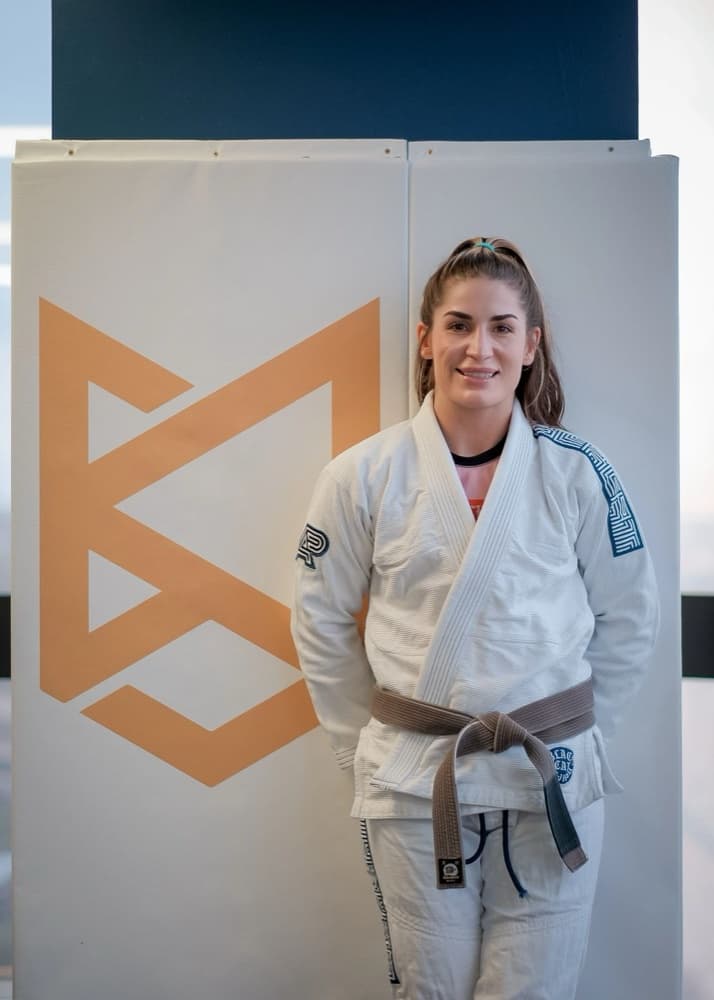
Short answer: jiu jitsu is one of the most practical things a woman can train, and you do not need to be an athlete or a fighter to start. Black Cat runs a dedicated women's only class where women train with women, included in one membership that also covers gi, no-gi, and wrestling. It holds up for self-defense because most real trouble ends up close and on the ground, which is exactly where jiu jitsu works. Beginners are the norm, not the exception. Here is the honest version from a black belt who runs the program.
Why Black Cat runs a dedicated women's class
Walking into a room full of strangers to grapple is intimidating for anyone, and it is a bigger hurdle for a lot of women. So we run a women's only jiu jitsu class where you train with other women, most of them beginners like you, in a room built to be welcoming. It is one of the things I am proudest of on our schedule.
It is not a watered-down version of the class the men take. It runs the same technique, the same drilling, and the same coaching standard as every other class we teach. The only difference is the room, and for a first-timer that room is often the thing that gets you through the door and keeps you coming back.
What a women's jiu jitsu class actually looks like
The format is the same one everyone at the academy follows, so after a couple of sessions it stops being a mystery. A class runs about an hour and has a predictable shape.
It opens with a warm-up that doubles as movement practice, not a punishment. Then a coach teaches one or two techniques slowly and explains why they work. Then you drill those moves with a partner at a controlled pace, taking turns, with no one trying to smash you. Some classes end with light live rounds dialed to your level. Nobody is thrown into the deep end, and a good partner protects a beginner. That is the whole culture of a well-run room.
Do you need to be fit or athletic to start?
No, and waiting until you are in shape is the most common reason women put off starting. You do not get in shape and then train jiu jitsu. You train jiu jitsu and it gets you in shape. The first couple of weeks will wind you, then your conditioning catches up faster than you expect.
You also do not need to be flexible, young, or a former athlete. The art is built on technique and position instead of raw strength, which is exactly why it suits someone who is not the biggest person in the room. If you can walk in the door, you can start.
Is BJJ actually good self-defense for a woman?
Yes, and I will give you the honest version instead of a sales line. Think about what an assault on a woman usually looks like. It is rarely a clean boxing match at arm's length. It is someone bigger grabbing, holding, and dragging, and it very often ends up on the ground. That close, grabby, on-the-ground range is the exact place jiu jitsu was built for.
What the training actually gives you is the ability to stay calm when someone has hold of you, protect yourself from a bad position, get back to your feet, and create the distance to get away. It teaches control, not striking, which is the version of self-defense that works when you are smaller than the person you are dealing with. For the deeper argument, read our honest black belt take on whether BJJ is good for self-defense.
I will also be straight about the limits. Jiu jitsu is not a magic spell, it does not beat a weapon, and awareness and getting away are always the first goal. But as a physical skill for the worst case, controlling and escaping a larger attacker is one of the few things that genuinely holds up under pressure.
Grappling versus a striking-based self-defense class
A lot of women's self-defense is taught as strikes: palm heels, knees, elbows. Those have their place. But here is the honest comparison for the situations women actually face.
| The situation | A striking approach | The jiu jitsu approach |
|---|---|---|
| Someone bigger grabs and holds you | Hard to generate power when you are held close and off balance | Frames, angles, and position break the grip and control the distance |
| You end up on the ground | Most striking training assumes you are standing | The ground is jiu jitsu's home range, where you are most dangerous |
| You need to stay safe, not win a fight | Trading blows with a stronger person is a bad bet | Control the position, protect yourself, get up, and get out |
| Adrenaline takes over | Fine motor strikes fall apart under panic | Positional habits drilled live still work when you are scared |
Neither is useless, and a complete person would want a little of both. But for the average woman against a larger attacker, control and escape beat trading strikes.
What jiu jitsu teaches about size and strength
People sell jiu jitsu with the line that leverage beats strength. That is not quite true, and I would rather tell you the real thing. Strength is real and it matters. What technique does is let you use your whole body, your hips, your frames, and a bigger person's own momentum, so that a strength gap matters far less than it looks from the outside.
In practice that means a woman who has trained for a year can control and escape a much larger untrained person, not because she overpowered them, but because she knew where to be and what to do while they burned energy. That is the honest promise of the art, and it is a big one.
Will I have to roll with big strong men?
Not in the women's class. That is the point of it. You train with other women, and for many members that is where they spend all their mat time and never feel the need to go further.
If you decide you want more mat time, the mixed adult classes are open to you on the same membership, and even there you are never obligated to roll hard with anyone. Partners are chosen for control, beginners drill light, and a training partner who cannot go easy with a smaller person does not last in my room. You set your own pace from day one.
What to wear and bring to your first class
Keep it simple. A fitted athletic t-shirt or a rashguard, and shorts or leggings without pockets, zippers, or buttons. Loose pockets catch fingers and toes. You do not need to own a gi for your first class, and if the session you drop into is a gi class we will sort out a loaner.
Come with short nails on your hands and feet, leave jewelry and your watch in your bag, and bring a water bottle. That is the entire list. For a full walk-through of the early weeks, here is what your first month of jiu jitsu actually looks like.
The women who train at Black Cat
There is no single type. The women in our program walk in for different reasons and all end up in the same welcoming room.
- The total beginner. Never trained anything, a little nervous, and the norm rather than the exception here.
- The woman who wants to feel safe. Motivated by self-defense, and she gets the most honest version of it.
- The one who wants a real workout. Jiu jitsu gets you in shape without it ever feeling like a treadmill.
- The future competitor. Some women catch the bug and start competing, and we corner them the same as anyone.
Beginners train next to experienced grapplers safely, because the room is built for it. You will never be the only new person on the mat.
How one membership covers the women's class
You do not have to choose between programs. One adult membership at Black Cat covers gi jiu jitsu, no-gi, the wrestling class, and the women's only class. Come to the women's class once a week to start, and if you want more mat time it is all included, no upgrade required. Most people start with the women's class and branch out from there at their own speed. You can read more about how it all fits together on the adult program page or the women's program page.
How to try the women's program at Black Cat
Reading about it only goes so far. The way to know if it fits is to feel one class in the actual room. We run the women's program in Springfield, Virginia, taught to the same standard as every class on our schedule, in a space built to be welcoming to a nervous first-timer.
Start with a trial class before you commit to anything, and we credit it toward your first month when you enroll. When you are ready, book a trial class and tell us it is your first time so we put you exactly where you should be. Most classes are taught by me, a second-degree black belt who competes at the international level and corners professional MMA fights, and I am on the mat for most of what happens in this academy.
Frequently asked questions about women's BJJ
Do I need any experience to start the women's class?
No. Most women in the program started with zero experience, and beginners are the norm rather than the exception. Come to a class, tell us it is your first time, and a coach will walk you through it step by step at a controlled, encouraging pace.
Is BJJ actually good self-defense for women?
Yes, honestly so. Most assaults on women get close, grabby, and end up on the ground, which is exactly where jiu jitsu works. It teaches you to control the position, protect yourself, get back to your feet, and create the distance to escape a larger person.
Will I have to train with men?
Not in the women's only class. You train with other women, most of them beginners. If you later choose the mixed adult classes on the same membership, partners are picked for control and you are never obligated to roll hard with anyone. You set your own pace.
Do I need to be in shape before I start?
No. You do not get fit first and then train. Training gets you in shape. The first couple of weeks will wind you, then your conditioning catches up quickly. You also do not need to be flexible, young, or a former athlete to start.
What should I wear to my first women's BJJ class?
A fitted t-shirt or rashguard and shorts or leggings without pockets, zippers, or buttons. You do not need a gi for your first class. Bring a water bottle, keep your nails short, and leave jewelry in your bag. That is the whole list.
