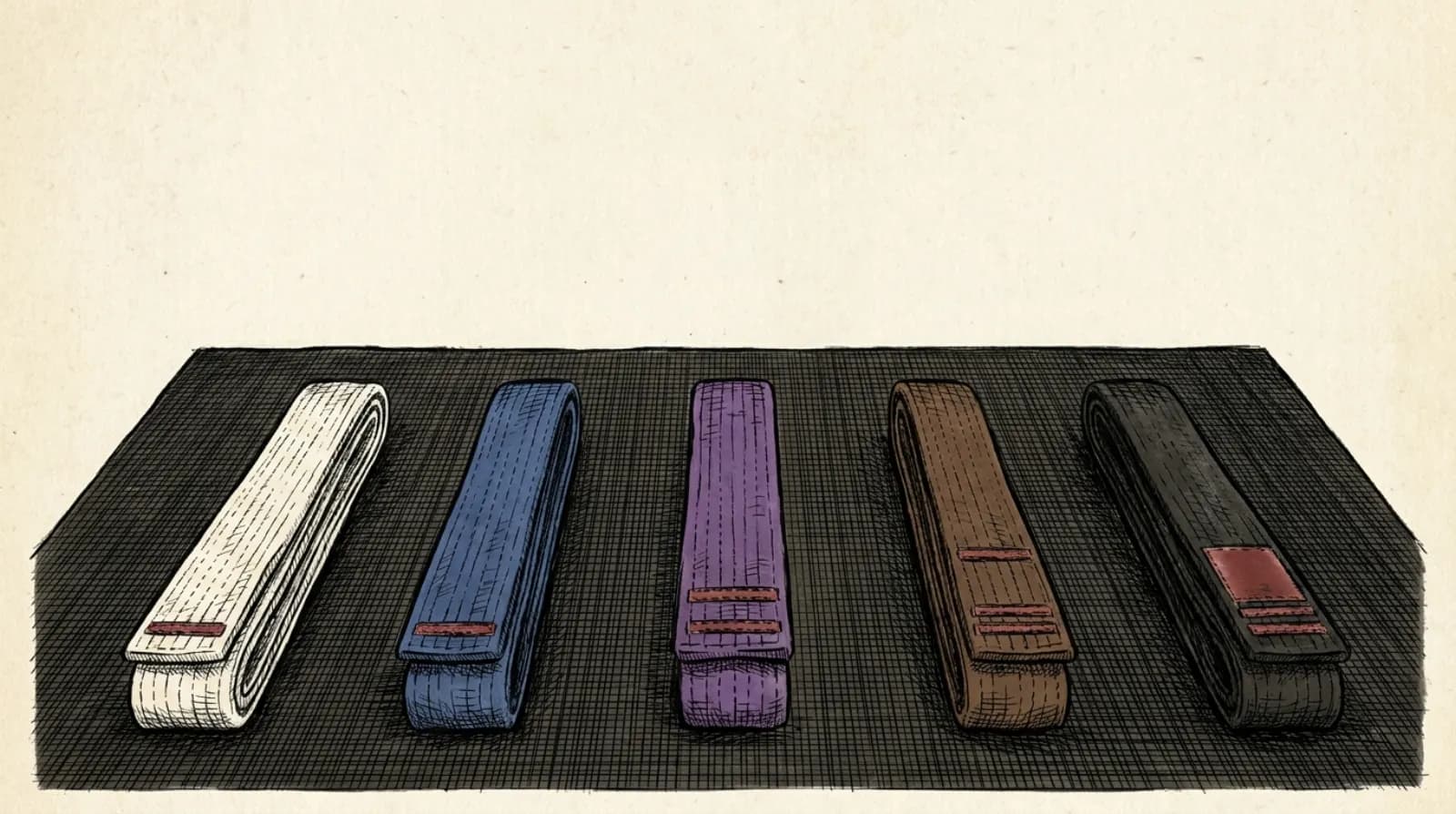
The adult BJJ belt ranks in order are white, blue, purple, brown, and black. Each colored belt can hold up to four stripes before the next promotion. Under IBJJF rules, you must be 16 for a blue belt and 19 for a black belt, with minimum periods at the later colored ranks. The clock makes you eligible. It does not earn the promotion.
The five adult BJJ belts in order
For anyone 16 and over, the ladder runs white, blue, purple, brown, and black. Five belts spread across years of training is why BJJ ranks move slowly. A blue belt here is not a beginner marker handed out after a short course. It means the student can use the fundamentals against resistance and train safely with other people.
The IBJJF graduation system sets the minimum ages and periods shown below. Those are floors, not a promotion schedule. A coach can require more time. Waiting out the minimum does not require the coach to promote anyone.
| Belt | IBJJF minimum age | Minimum at previous belt | What the minimum means |
|---|---|---|---|
| White | Adult starting rank | None | Where every adult begins |
| Blue | 16 | No fixed adult minimum at white | The instructor decides when the standard is met |
| Purple | 16 | 2 years at blue | Eligibility begins after the minimum |
| Brown | 18 | 18 months at purple | Eligibility begins after the minimum |
| Black | 19 | 1 year at brown | Eligibility begins after the minimum |
The dates in the table establish eligibility. Skill development and the instructor's standard still decide the real promotion date.
What promotion needs to show
Attendance matters because a student cannot learn without training, but attendance alone does not demonstrate skill. Technique has to work when a partner adds real resistance. A movement performed only on a cooperative partner during drilling has not passed that test yet.
Rank also becomes clearer when the student can recognize a bad position, protect themselves, make a sound decision, and work out without panic. The exact techniques and weight the instructor gives each factor vary by academy.
Training control matters too. Being able to dominate a new student does not prove much by itself. A higher-ranked student should be able to control the round, respect the tap, and give the newer person a useful place to work. The instructor owns the final standard.
Why time at the belt still matters
Skill needs time against different people and different problems. A technique that worked for one month may fail when partners learn the counter. Staying at a rank long enough exposes those weak spots and gives the student a chance to repair them. That is why promotion cannot be reduced to attendance, one tournament result, or a list of moves performed once.
Minimum periods protect the floor at the later ranks, but they do not define the ceiling. The instructor still has to judge whether the student's decisions, control, and understanding hold up across normal training.
What stripes mean
Every adult belt from white through brown can hold up to four stripes on the black bar. A four-stripe blue belt is still a blue belt. The stripes are checkpoints inside a rank, not separate ranks.
They exist because the gap between belts can run for years. A smaller marker can show that the coach sees progress while the student keeps building the skills required for the next belt. Adult stripe timing is not standardized across every academy, so another gym's calendar does not control yours.
White belt: learning to survive and understand the map
White belt is where you learn where your limbs go, how to breathe under pressure, when to tap, and how to move without hurting your training partner. Almost nothing works cleanly on an experienced person at first. That is the expected starting point.
The early measure is not how many submissions you collect. It is whether you can recognize common positions, protect yourself, escape with a sequence instead of panic, and return for the next class. If you want the practical first-visit details, read what the first month of BJJ looks like.
Blue belt: building a game that works
Blue is the first adult colored belt. The student should have reliable escapes, a guard they understand, a way to pass, and a few attacks that connect to the positions they can reach. They are no longer only reacting. They can begin steering a round toward something they know.
This is also where progress can become harder to see. At white belt, almost every class introduces something new. At blue, the gains may be smaller: a better grip, a cleaner angle, or a decision made a second earlier. A repeatable training routine gives those smaller changes time to accumulate.
How long does it take to get a blue belt?
There is no universal blue-belt date. The IBJJF does not set a fixed adult minimum at white belt, so the rulebook cannot answer how long a specific student will take. Training frequency, interruptions, skill development, and the academy's standard all affect the decision.
The useful test is not whether the calendar says a year has passed. It is whether the student can use the basic positions against resistance, make sound decisions when tired, and train safely with both newer and more experienced partners. A guaranteed promotion date is a sales promise, not evidence of skill.
Purple belt: making the jiu jitsu your own
Purple is where a student usually stops trying to collect every technique and starts choosing what fits. Body type, mobility, preferred positions, and the kinds of problems they solve well begin to shape an individual game. Two purple belts from the same room may look completely different.
The IBJJF minimum is two years at blue before purple for the standard adult path. That is the longest listed minimum between the adult colored belts. It still establishes eligibility rather than a deadline. A student has to show the depth and connection expected by the instructor.
Brown belt: sharpening what already works
Brown follows purple and comes before black. By this point, very little of the work is a brand-new foundation. The student is improving timing, joining positions, removing wasted movement, and closing the openings that a black belt would find.
The standard IBJJF minimum is 18 months at purple before brown, and the minimum age is 18. In practice, many students spend longer at purple. Some brown belts also begin helping newer students or assisting in class, but those roles depend on the academy. The promotion itself still belongs to the instructor.
Black belt: command of the system, not the end of learning
The standard IBJJF path sets a minimum age of 19 for black belt and at least one year at brown, with limited competition exceptions in the governing rules. In reality, most people need far longer than the listed minimums because the rank is about command of the whole system, not just time served.
Black belt is not the end of learning. It means the student can connect positions, solve unfamiliar problems, and be trusted with the level of skill the rank represents. Questions become more specific as the work continues.
How long does it take to get a black belt?
The rules do not create one reliable black-belt timeline. The minimum periods at blue, purple, and brown establish a floor for the standard adult path, while the time before blue and any extra time at later ranks remain open. Technical development takes as long as it takes.
More classes may create more opportunities to learn, but the relationship is not perfectly linear. Training quality, recovery, injuries, work, family, and time away from the mat can all change the path. A coach who has not evaluated the student cannot promise the date.
How to read the IBJJF graduation rules
Check three separate things: the minimum age for the target belt, the minimum period at the current belt, and any exception that applies to the student's division or competition result. Passing all three checks means the student may be promoted under the rules. It does not mean the promotion must happen.
Rules can also change. Use the linked IBJJF source for the current governing text rather than copying a timeline from an old graphic. Then ask the academy how it applies its own technical standard inside that floor.
What comes after black belt?
After black belt, rank is counted in degrees. The first three degrees each require three years under the IBJJF system. The fourth, fifth, and sixth require five years each. That puts a sixth degree roughly 24 years beyond the original black-belt promotion.
The belt changes after sixth degree. Seventh degree is the red-and-black belt, commonly called a coral belt. Eighth is the red-and-white coral belt. Ninth degree is the red belt. Those ranks represent decades at black belt and are rare by design.
Youth belts use a different system
Children do not move through a shortened version of the five adult belts. Their system uses white, grey, yellow, orange, and green, with solid, white-striped, and black-striped versions inside the colored families. That creates 13 youth ranks before the adult system.
- Grey-family belts become available at age 4.
- Yellow-family belts become available at age 7.
- Orange-family belts become available at age 10.
- Green-family belts become available at age 13.
- An adult blue belt is not available before age 16.
Age makes a belt available. It does not require the promotion. Parents should use the current IBJJF graduation rules and the instructor's explanation instead of planning around a fixed date. Black Cat's kids BJJ guide explains how the youth ladder relates to the ages 8 to 13 Black Kittens program.
Start with training, not a deadline
The belt is the record of work already done. It is a poor reason to rush the work itself. The people who stay long enough to reach the later ranks learn to value the training between promotions, because most of their time will be spent there.
Black Cat's adult program includes gi, no-gi, wrestling, and the women's program under one membership. If you are new, read the first-month guide, then request a trial class. Staff will contact you to confirm the right class at the academy in Springfield, Virginia.
Frequently asked questions about BJJ belt ranks
What are the adult BJJ belts in order?
White, blue, purple, brown, and black. Each colored belt can hold up to four stripes before the next promotion. Children use a separate youth system before becoming eligible for an adult blue belt.
How old do you have to be for a blue belt?
Sixteen under the IBJJF system. There is no fixed adult minimum time at white belt, so the promotion still depends on skill and the instructor's standard.
How long does blue to purple take?
The standard IBJJF minimum is two years at blue. Many students take longer because the minimum only makes the promotion eligible; it does not guarantee it.
What do stripes on a BJJ belt mean?
They mark progress inside a rank. Adult stripe timing varies by academy, and a stripe does not create a new rank or a guaranteed next promotion date.
How long does a BJJ black belt take?
There is no universal date. Later ranks have minimum periods, the time before blue is not fixed by the adult IBJJF rules, and the student still has to meet the instructor's technical and training standard.
What comes after black belt?
Black-belt degrees come next, followed much later by the seventh-degree red-and-black coral belt, eighth-degree red-and-white coral belt, and ninth-degree red belt.