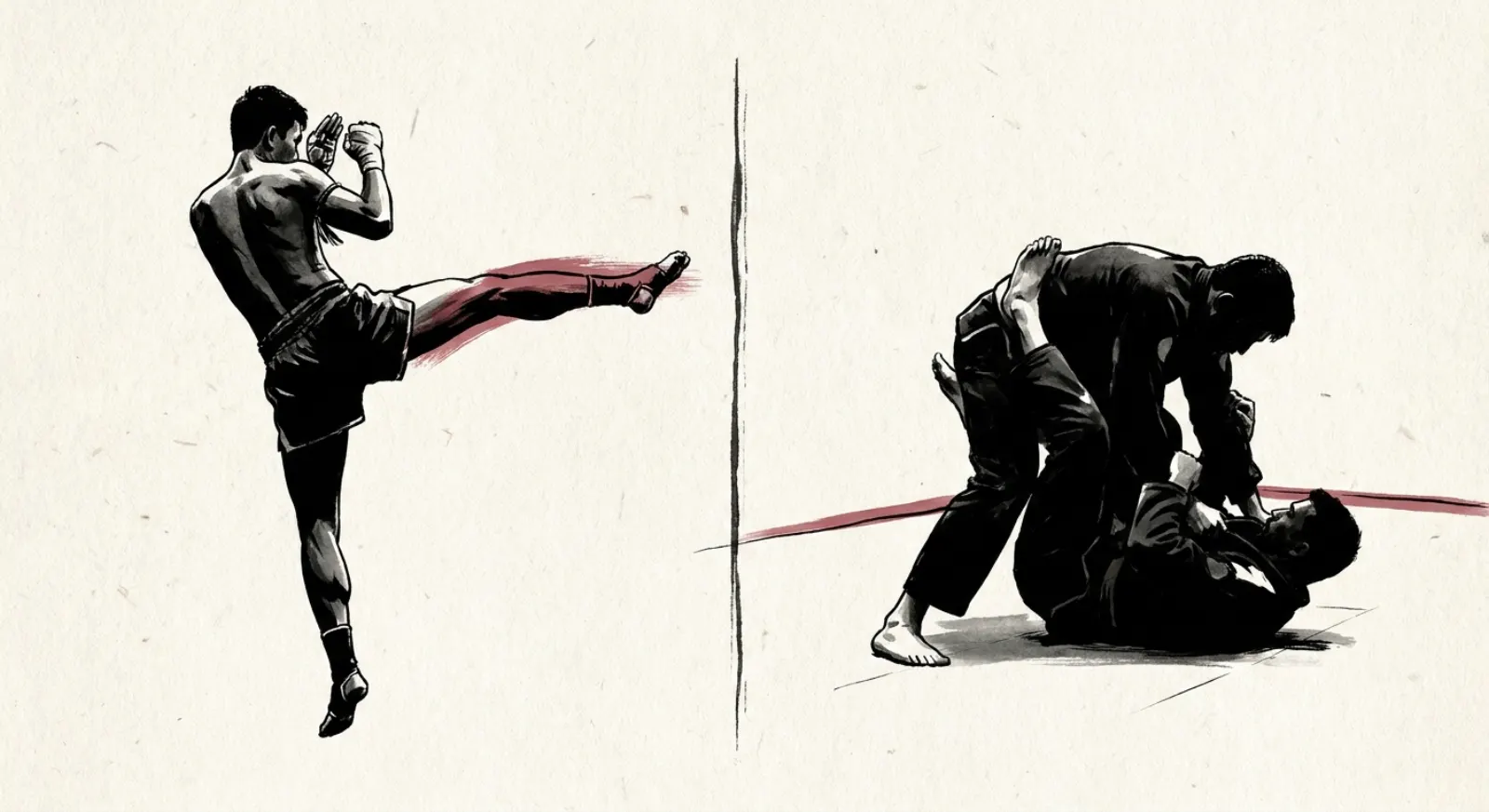
Split ink illustration: a Muay Thai fighter mid round kick on the left, two jiu jitsu grapplers in a ground exchange on the mat on the right.

Brazilian Jiu Jitsu

BJJ vs Muay Thai: Which One Should You Train First?

August 1, 202610 min readAdam Benayoun
Brazilian Jiu JitsuMuay ThaiMMABeginners

Short answer: Muay Thai owns the fight at striking range, and jiu jitsu owns it once that range collapses. Neither one covers the other's range, which is why people serious about fighting end up training both. We teach jiu jitsu and wrestling at Black Cat, not Muay Thai, and I'd rather say that up front.

What each art is built to do

I'm a jiu jitsu black belt who corners professional MMA in the UFC, ONE FC and FURY FC, so I watch strikers and grapplers meet under live rules on a regular basis. Here is how the two arts divide the work.

Muay Thai is a striking art. Everything in it is organized around a stance, a distance, and doing damage from there with fists, elbows, knees and shins. Win the distance and you win the exchange, and losing it is how strikers lose fights.

Brazilian jiu jitsu is a grappling and submission art. It assumes the distance is already gone and somebody has hold of you, and it teaches you what to do about that: control the position, work from on top or from underneath, and finish with a choke or a joint lock.

They aren't really competing for the same job. The useful question isn't which art is better. It's which range you want to be dangerous in, and which range you're likely to end up in.

BJJ vs Muay Thai at a glance

 Brazilian Jiu JitsuMuay Thai
Main goalControl the position and force a submissionDo damage from striking range
Where the fight happensClinch and the floorStanding, at kicking and punching range
How you winSubmission, or points from positionKnockout, stoppage or points
What you learn firstPosition, posture and escapesStance, guard and the round kick
Contact to your head in trainingAlmost noneRegular, once you start sparring
Full-speed practice against someone resistingMost classesSparring days only, with control
Useful when someone grabs youDirectlyLess so at that range
Useful when someone stays at arm's lengthLess soDirectly
Ground fightingThe whole sportNone. The referee stands you back up
Common complaints after a yearFingers, knees, a stiff neckShins, ankles, hands, head
GearA gi, or a rash guard and shortsGloves, wraps, shin guards

What the art of eight limbs means

Muay Thai gets called the art of eight limbs because it uses eight points of contact: two fists, two elbows, two knees, two shins. Boxing gives you two. That's the whole idea. Four times the weapons, and each one owns a different distance, so there's no gap in the ladder between far away and chest to chest.

The professional format in Thailand is five rounds of three minutes with two minutes of rest, and elbows are legal there. Amateur rules vary a lot: youth divisions restrict elbows and head strikes, plenty of novice circuits ban elbows outright, and adult elite bouts under international rules allow them with pads. That's one reason a beginner's amateur bout and a Bangkok stadium fight can look like two different sports. Thai judges also weight the later rounds more heavily than the early ones, so fighters feel each other out and then commit. If your only exposure is highlight clips, that pacing is a surprise.

The elbow is the piece that changes a game plan. When I'm cornering against someone with a Thai background, the clinch stops being a place to rest and starts being the most dangerous place on the canvas, and the instruction between rounds changes accordingly.

Where Muay Thai wins: distance, damage and the clinch

Muay Thai's advantage is blunt. It's the only one of the two that can end things before anyone gets close, and it reaches further than boxing does. A kick lands from outside punching range. A knee lands from inside it. Nothing in jiu jitsu answers a person who's good at that and wants to stay right there.

The part people underrate is the clinch. Muay Thai's clinch is a full game of its own: hands on the head and neck, a fight for the inside position, knees to the body and the head, and trips and sweeps to put someone down. Wrestling takedowns and judo throws aren't part of the ruleset, so it stays standing, but the control is serious. A Thai clinch is miserable for a grappler who expected to walk into a body lock unopposed.

And the conditioning is not optional anywhere I've seen. Whatever else you get out of a Muay Thai gym, you'll be in shape.

Where jiu jitsu wins: everything after the distance closes

Once somebody has hold of you, striking range is gone, and most of what Muay Thai trains goes with it. That's jiu jitsu's whole territory: the clinch, the wall, the floor. If a fight ends up there, the grappler decides what happens next.

Two things make jiu jitsu unusual as a training method. First, you can practice it at full speed against a person genuinely trying to stop you, most classes, and both of you walk out fine. Striking has no equivalent. Hard sparring can't be a daily habit and stay safe, which is why strikers drill far more than they fight. Second, we have submissions, so a smaller person has a way to end it rather than only a way to survive.

The limit runs the other direction and it's just as real. Jiu jitsu has no answer for someone who keeps their distance and hits you. Standing in front of a Muay Thai fighter with only a guard game is its own bad idea.

The rules of each sport explain most of the gap

Each sport's rules tell you where its people will have holes.

Muay Thai has no ground fighting. Go down and the referee resets you standing, so there's no reason to develop anything on the floor and nobody does. The takedown is limited too, since wrestling-style shots and throws sit outside the ruleset while sweeps and trips sit inside it.

Jiu jitsu has no strikes. Nobody's punching you while you work, so guards get built that wouldn't survive a fist, and a long stalemate on the bottom is a workable match strategy and a terrible everywhere-else strategy. Every jiu jitsu player who starts MMA finds out fast which parts of their game were rule-dependent.

Neither sport is wrong. Each is complete for its own rules and full of holes under the other's.

What I see from the corner of a professional fight

This is the part I have a seat for. Cornering in the UFC, ONE and FURY, the same pattern turns up: the striker controls the fight until the grappler closes the gap, and the grappler controls it from the moment they do. Whoever gets to fight in their own range is usually the one whose hand goes up.

So the skill deciding a lot of fights isn't striking or grappling. It's the transition. Getting in without eating a knee, or peeling someone off you and putting them back at the end of your punches. A fighter who can't manage that gets fought in somebody else's range all night, however good the rest of it is.

The early UFC made the point crudely. At UFC 1 in 1993, Royce Gracie submitted the savate fighter Gerard Gordeau with a rear naked choke in the final, in under two minutes, and the sport spent three decades correcting for it. Nobody at the top is only one thing now.

Which is better for self-defense, Muay Thai or BJJ?

They're honest answers to different halves of the problem, and anyone telling you either one is the whole answer is selling you something.

Muay Thai's answer is faster when you have space. Keep the distance, hit hard, leave. If you can use it, that's the better outcome, because nothing about being on the ground with a stranger is safe.

Jiu jitsu's answer is for when the space is already gone. Someone grabs you, pins you against a car, ends up on top of you. Knowing how to throw a kick doesn't help much there, and knowing how to move under someone's weight helps enormously. Jiu jitsu is also the only one of the two that gives you a way to hold a person still without hurting them, which matters more often than people expect. We went deeper into where it works and where it stops in is BJJ good for self-defense.

Neither one answers a weapon, and neither one answers more than one person.

What a year of each one costs your body

Worth being straight about, since it's the question beginners ask least and regret most.

Muay Thai's cost is impact. Shins, hands and ankles early, and once you're sparring, shots to the head. A careful gym manages that and a careless one doesn't, and that difference matters more than any other feature of the place. If you're thirty-five with a job and kids, it's worth weighing honestly rather than deciding you'll be the exception.

Jiu jitsu's cost is joints and time spent under another person's weight. Sore fingers, a stiff neck, a knee that complains on the stairs. Almost nobody takes a shot to the head. That's a large part of why people are still training jiu jitsu in their fifties, and we have people on the mat in their fifties.

Which should you start with if you've never trained?

If you're only picking one, start with the range you're most likely to be stuck in. For most adults who aren't planning to fight, that's grappling, because the situations people describe to me involve being grabbed, not being at kicking distance.

If you want to compete, or you simply like striking, start with Muay Thai and don't apologize for it. Enjoying it is the only reason anybody sticks around long enough for it to work.

The practical version: try one class of each and go back to the one you're still thinking about on Wednesday. If it helps, here's what your first month of jiu jitsu really looks like, and how to tell a good gym from a bad one before you sign anything.

Can you train both, and in what order?

Yes, and most people who stay in martial arts end up doing exactly that. The order matters less than being honest about your week. Two arts at two sessions each is four evenings, and that's the part people underestimate, not the training.

Starting from zero, one at a time for six months beats both at once badly. Pick the one you're drawn to, get past the stage where nothing makes sense yet, then add the other. If you already grapple, the Muay Thai clinch will come quickly, because you understand posture and pressure already. Going the other way, a striker's first month of jiu jitsu is humbling in a specific way: you're strong, you're fit, and none of it works yet.

For the comparisons next door to this one, we've covered BJJ vs wrestling and BJJ vs judo.

Where Black Cat fits, and what we don't teach

We teach jiu jitsu and wrestling. No Muay Thai, no striking classes. If striking is what you want, go find a good Muay Thai gym and I hope you love it.

What we do cover is the entire grappling half under one membership: gi and no-gi jiu jitsu, wrestling for the takedown game, and a women's program. Wrestling is the piece that decides whether a fight stays standing, which is the same job the Muay Thai clinch does from the other side of it. If you're weighing whether to train in a gi at all, that's covered in gi vs no-gi.

I'm a second-degree black belt and an IBJJF Open champion at black belt, and I teach most of the classes myself. I earned my belts under Lucas Lepri and Marcelo Garcia. If you've never grappled, you'll start at the beginning like everyone else did. Come take a free trial class in Springfield and find out whether the ground half is the half you want.

Is BJJ or Muay Thai better for self-defense?

They cover different ranges. Muay Thai is better when you have space to keep someone off you. Jiu jitsu is better once you've been grabbed or taken down, which is where a lot of confrontations end up. If you can only train one, pick the range you're most likely to be stuck in.

Would a BJJ black belt beat a Muay Thai fighter?

It depends on where the fight happens. At striking range the Muay Thai fighter is the favorite. In a clinch or on the ground the black belt is. The honest question is who gets to fight in their own range, not who trains the better art.

Can you learn Muay Thai and BJJ at the same time?

Yes, and plenty of people do. If you're brand new, one at a time for the first six months works better. Get past the stage where nothing makes sense, then add the second. Count the nights honestly first: two arts, twice a week each, is four evenings gone.

Which is harder, Muay Thai or BJJ?

Muay Thai is harder on your body and easier to understand. Jiu jitsu is easier on your body and much harder to understand, because you're solving a puzzle while somebody actively ruins it. Beginners usually find the first Muay Thai month more exhausting and the first jiu jitsu month more confusing.

Does Muay Thai have any ground fighting?

No. It's a standing sport and the referee resets fighters when someone goes down. Sweeps and trips from the clinch are allowed, but there's no ground game to develop, so a Muay Thai fighter's floor skills come from somewhere else or not at all.

Does Black Cat teach Muay Thai?

No. We teach gi and no-gi jiu jitsu plus wrestling, all on one membership, at our Springfield academy. For striking you'll need a separate Muay Thai gym. Wrestling covers the takedown side of your game, which is the standing skill that decides where a fight goes.