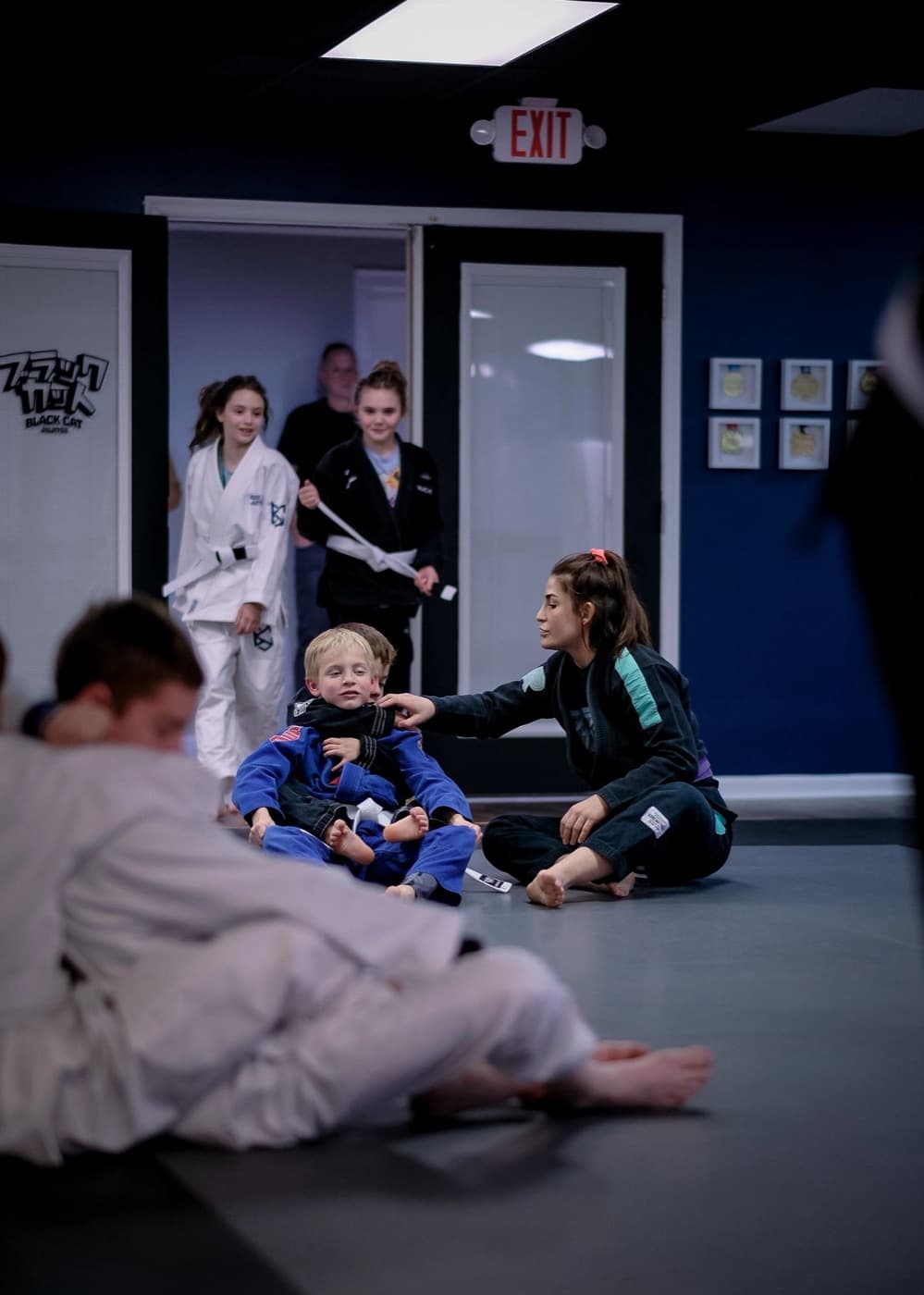
Short answer: yes, people get hurt doing jiu jitsu, and the published rate lands somewhere between one injury per three athletes per year and roughly one per 180 hours of training, depending on how a study defines an injury. Almost all of it happens during sparring, the knee is the joint that suffers most, and in my experience the biggest variable isn't a technique, it's who you're rolling with. That last part is the part you and your gym control.
Why I'd rather answer this with numbers than reassurance
I've been asked some version of "am I going to get hurt" by nearly everyone who's ever walked into the academy for a first class. The honest answer isn't "no." It's a number, and a short list of things that change it.
I'm a second-degree black belt, I own the academy in Springfield, and I teach most of the classes myself. I also corner professional fights in the UFC, ONE FC and FURY FC, so I've watched what happens at the end of the sport where people are actually trying to hurt each other. A Tuesday night class is not that. But it isn't a yoga class either, and a gym that tells you it is will lose your trust the first time you jam a finger.
So here's what the research says, what it misses, and what I've seen on my own mat.
What the two biggest jiu jitsu injury studies found
There are two large studies worth your time. A 2021 survey of 1,140 athletes published in the Orthopaedic Journal of Sports Medicine, and a 2025 global survey of 881 practitioners in BMJ Open Sport and Exercise Medicine. They were built differently, so they don't agree on everything, and the places they disagree are as useful as the places they don't.
| 2021 survey (1,140 athletes) | 2025 survey (881 practitioners) | |
|---|---|---|
| Injury rate | 308 injuries per 1,000 athletes per year | 5.5 per 1,000 training hours, 55.9 per 1,000 matches |
| Most injured area | Knee, 27.1% | Knee 25%, shoulder 13% |
| Where it happened | 77.6% during sparring | 89% in training, 79% of those in sparring |
| Leading causes | Submissions 29.7%, takedowns 26.4% | Not broken out the same way |
| Who got hurt more | Regular competitors, older athletes, higher belts | Higher rate at lower belt levels |
| Worst for time off | ACL tears | Not broken out the same way |
Those two rates aren't comparable head to head. One counts injuries per athlete per year, the other per hour on the mat, so how much you train changes the answer. The definitions differ too, and not the way you'd guess: the 2021 study only counted an injury if it cost two full weeks, while the 2025 one counted a week off, two weeks modified, or a trip to a doctor. Read the range, not either number on its own, and be suspicious of anyone quoting one decimal place at you.
What matters more than the exact figure: both studies land on sparring and the knee. The third thing, who you're rolling with, is my read rather than theirs, and it's the one I'd bet on.
Why the knee tops every injury list
Submissions caused the most injuries in the 2021 data, at 29.7%. Yet the knee is the joint that gets hurt most, and almost nobody gets kneebarred in a beginner class. Those two facts look contradictory until you've spent time on a mat.
Here's the mechanic. When an armbar locks in, you feel it arrive, and you get most of a second to tap. That second is the whole safety system of this sport, and it works. A knee doesn't give you that. A knee gets hurt in a scramble, when someone's weight lands on it at an angle while both people are moving and neither of them chose anything. There's no moment to tap because there's no submission to tap to.
The 2021 study lists meniscus tears, ACL tears and MCL injuries as the knee injuries showing up most. Some of those come from leg locks. Plenty of them, in what I see, come from scrambles nobody chose.
The practical version: the techniques with a name are the safe part. It's the unnamed chaos in between that costs people months.
Sparring is where it happens, and that's good news
Both studies land in the same place here. 77.6% of injuries during sparring in one, 79% in the other, with 89% of all injuries happening in training rather than competition.
That sounds alarming and it's actually the most useful thing in the data, because sparring is the most controllable thing in a gym. Nobody is forced to spar. Nobody has to spar on day one, or in their first month, or with the biggest person in the room. How a gym introduces you to live rounds is a policy decision that gym makes, and it's the biggest lever you or your gym has.
When you visit somewhere, ask when new people start rolling and who they roll with. The answer tells you more about your odds than any technique on the wall. I go through the rest of what to look for in how to choose a BJJ gym.
The tap is a decision, and most injuries are the decision going wrong
The overwhelming majority of submission injuries I've seen weren't caused by the submission. They were caused by someone deciding not to tap.
Ego shows up in specific, predictable moments: a bigger guy who doesn't want to tap to a smaller one, a new white belt who thinks tapping means losing, a competitor at a Tuesday class training like it's a final. In each case a joint that would've been fine gets loaded for two extra seconds.
Tapping isn't losing. It's the mechanism that lets adults practice joint locks on each other several times a week for decades. A gym where people tap early is a gym where people are still training at 50.
Your training partner is the risk, not the technique
New people worry about heel hooks and chokes. What actually hurts them is a specific kind of partner: someone stronger than their control, moving faster than their skill, treating a round as a thing to win.
This isn't a personality problem you can screen for at the door. It's a culture problem, and culture comes from whoever runs the room. If the head instructor is on the mat and stops a round that's heating up, the problem stays small. If the room is unsupervised and the loudest blue belt sets the tone, it doesn't.
This is a large part of why I teach most of the classes myself rather than handing the schedule to a rotating staff. It isn't only about instruction quality. Somebody has to be watching.
Leg locks are the one genuinely different risk
Most jiu jitsu submissions give you a warning. A choke gives you time. You feel it coming and you tap, which is why almost nobody in a normal class ever goes out. Most arm locks hurt before they do damage, and that gap is what makes tapping work.
Heel hooks are the exception. A heel hook attacks knee ligaments through rotation, and ligaments can fail before your brain registers pain. The warning window that makes everything else safe is much shorter, and sometimes it isn't there.
That's a technique that belongs in front of people who've earned it, with partners who've earned it. It's why good no-gi rooms have a policy on when leg locks enter your game, and why "we let everyone do everything from day one" is a red flag rather than a sign of an advanced gym. If you're weighing the two styles generally, that's in gi vs no-gi.
The injuries the big studies never count
Both large studies used a time-loss definition, so anything that didn't stop you training didn't get counted. That erases the most common complaint in the entire sport.
A smaller 2023 survey in Cureus asked practitioners which body parts they'd hurt, counting anything that interrupted or changed training rather than only what cost them two full weeks. 78.6% of the 56 people surveyed had hurt a finger or hand at some point, against 61.5% for the knee. That's a count of people, not of injuries, so don't stack it against the percentages above. It's also a small sample, so lean on the direction, which matches what I see every week.
Jammed fingers, sore knuckles, a rib that complains for a month, a stiff neck after a hard week. Nobody misses class for those, so no time-loss study records them, and they're the actual texture of training. Gi grips are hard on hands. That's the trade.
Is jiu jitsu safe for kids, and what does the ER data show?
Parents ask this more than anyone, and there's finally data. A 2025 study in the Hawaii Journal of Health and Social Welfare pulled ten years of US emergency department records and found 264 emergency room records of pediatric jiu jitsu injuries, which the authors scale to a national estimate of about 8,400, average age 11.6, most commonly sprains and strains at 28.3% and fractures at 20.1%. Most were treated and sent home without being admitted.
The count rose over the decade. Read that carefully, because it's the kind of number that gets misused. Participation rose enormously across the same ten years, and a rising count alongside a rising population isn't a rising rate. The study can't tell you the rate, and neither can I.
What I'd tell a parent instead: kids' jiu jitsu risk is mostly about how the class is run, whether kids are matched by size, and whether an adult is actually coaching rather than supervising. Our Black Kittens program for ages 8 to 13 groups kids that way on purpose. There's more on the program in BJJ for kids.
What the two studies disagree about, and why it matters to you
The 2021 survey found higher belt rank was a risk factor. The 2025 survey found a higher injury rate among lower belts. That's a flat contradiction and I'm not going to pretend otherwise.
My read, and it's a read rather than a finding: they're measuring different populations doing different things. Higher belts compete more and roll harder, which raises exposure to serious injury. Lower belts have less control, spend energy where a skilled person wouldn't, and pick up more of the small stuff. Both can be true at once because the studies weren't counting the same injuries.
What you should take from it: nobody trains their way to zero risk. What changes is the kind of risk. Beginners get hurt by inexperience. Advanced people get hurt by intensity. The middle years, when you're strong enough to hurt someone but not skilled enough to avoid it, are the ones I watch hardest.
Starting in your 40s or later
Older age was a risk factor in the 2021 data, and I'm not going to argue with it. Tissue recovers slower, and it's true.
What that doesn't mean is that you shouldn't start. It means you train differently on purpose. You pick your rounds instead of taking every one. You sit out the round with the 22-year-old wrestler who just discovered a new pass. You tap earlier, not later, because you have nothing to prove and a job on Monday. We have people on the mat in their forties and fifties training several times a week.
The people who get hurt starting later are almost always the ones training like they're 25, not the ones who are 45.
How to judge a gym's actual safety before you sign
Watch a class before you commit. Five things tell you nearly everything:
- Who's teaching. Is the person with the credentials on the mat, or is their photo on the wall while somebody else runs the room?
- When beginners spar. If nobody at the desk can answer that, there's no policy.
- Who gets paired with whom. Watch whether a 130-pound newcomer gets put with a 220-pound competitor.
- What happens when a round heats up. Somebody should notice. If nobody does, that's the answer.
- The leg lock policy. "Everyone, from day one" is not a sign of an advanced room.
None of that requires you to know anything about jiu jitsu. You're evaluating supervision, not technique.
How we handle it at Black Cat
New people drill before they spar, and they aren't put in with whoever happens to be free. Leg locks are gated by experience rather than open to the room. And I'm on the mat for most classes, which means a second-degree black belt is watching the pairs that need watching.
One membership covers gi and no-gi jiu jitsu, wrestling, and our women's program, so nobody has to spar to justify their money. Plenty of people train for a year mostly drilling and are better for it.
I'd rather you came in knowing the honest version. Come take a free trial class in Springfield, watch a round, and decide with your own eyes. If you want to know what the first few weeks are actually like, that's in your first month of BJJ, and the self-defense side is in is BJJ good for self-defense.
Is BJJ more dangerous than other martial arts?
It has no strikes to the head, which removes the main source of serious harm in striking arts. What it adds is joint locks and scrambles, so you trade concussion risk for knee and shoulder risk. Different profile, not simply safer. Compare it to judo if you're deciding.
What is the most common BJJ injury?
Depends how you count. Among injuries that cost training time, the knee is about a quarter of them. Ask people which body part they've hurt at all and fingers and hands top the list. Both are true. The knee costs you months, your fingers cost you nothing but comfort.
How likely am I to get injured doing jiu jitsu?
Published rates run from about 308 injuries per 1,000 athletes per year to 5.5 per 1,000 hours of training, depending on the definition used. Your own odds depend far more on how often you spar, who with, and how early you tap than on any average.
Can you do BJJ without sparring?
Yes. Sparring accounts for close to 80% of injuries, so a person who drills and skips live rounds carries a fraction of the risk. You'll progress slower, and that's a fair trade for plenty of people. Any decent gym will let you sit rounds out.
Is jiu jitsu safe for a 40 year old beginner?
Yes, with adjustments. Older athletes showed higher injury risk in the research, and the fix is choosing your rounds, tapping early and skipping the hardest partners rather than proving something. We have members in their forties and fifties training several times a week.
Are heel hooks dangerous for beginners?
More than other submissions, yes. A heel hook can damage knee ligaments before pain gives you time to tap, so the warning window that makes other submissions safe is shorter. That's why experienced rooms gate them by level rather than opening them to everyone immediately.
