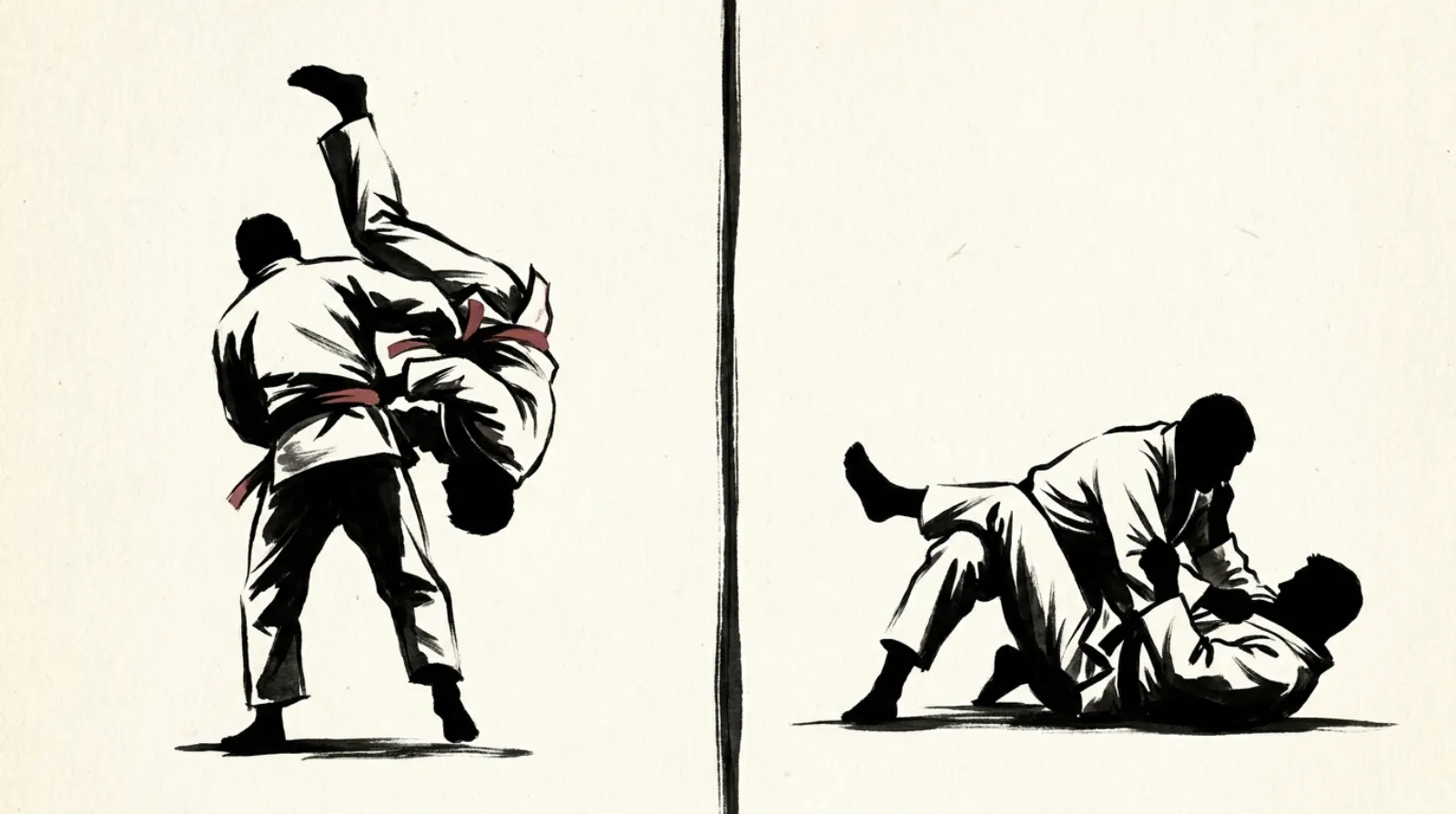
Split ink illustration: a judo throw at its apex on the left, two grapplers working a ground exchange on the mat on the right.

Brazilian Jiu Jitsu

BJJ vs Judo: Which Should You Train? A Black Belt's Take

July 30, 20269 min readAdam Benayoun
Brazilian Jiu JitsuJudoGrapplingBeginners

Short answer: judo wins the fight standing and jiu jitsu wins it on the ground. Judo has the deepest throwing system in grappling with a jacket on, built around gripping, breaking your balance, and putting you hard on your back. Jiu jitsu assumes you're both already down there, and teaches you to control, escape and finish from any position, including flat on your back. The competition rules of each sport are what made them that way. I'm a jiu jitsu black belt and not a judo black belt, so take this as one grappler's honest read on both.

The short version: what each art is built to do

Judo is a throwing art. A judo match is a fight over grips and posture, and it can end in a second when someone lands a clean throw. Groundwork exists in judo, but the referee stands you back up as soon as nothing is happening down there, so the ground portion of a judo match is short by design.

Brazilian jiu jitsu is a ground-control and submission art. It picks up where the throw lands, and it never resets. Guard, passing, position, chokes, joint locks. A jiu jitsu match can be ten straight minutes on the floor, which is exactly why the ground game there got so deep.

BJJ vs judo at a glance

 Brazilian Jiu JitsuJudo
Main goalControl and submit on the groundThrow the other person onto their back
The standing gamePresent, but the secondary skillThe whole foundation: grips and off-balancing
Fighting off your backThe guard, a full attacking positionTreated as losing, so it is avoided
Legal submissionsChokes plus joint locks on most joints, legs includedChokes and elbow locks only
Grabbing a leg to take someone downLegalBanned, penalized with a shido
Time on the groundUnlimited while the match runsShort: the referee resets you standing when progress stops
Gi or no giBoth trainedAlmost entirely gi
Impact on your bodyLower. Most of the work happens on the mat, not in the airHigher, you learn to be thrown and to land
Starting as an adult with no athletic baseStraightforwardDoable, but breakfalls come first
Olympic sportNoYes. Men from 1964, women from 1992

Jiu jitsu came out of judo

These are not rival arts with separate roots. In 1914 a Kodokan judoka named Mitsuyo Maeda settled in Brazil and taught the judo of his era, which still carried a heavy ground component. Carlos Gracie learned it there, and what his family built over the following decades became Brazilian jiu jitsu. Exactly who taught whom is still argued over by people with better archives than mine. What nobody argues about is the direction each art took afterwards. Judo kept developing the throw and became an Olympic sport, and jiu jitsu kept developing the floor.

Where judo wins: the grip and the throw

Nobody grips like a judoka. The whole art is organized around taking the grip you want, denying the one they want, and using it to break someone's posture before they know it's broken. That off-balancing is a skill most jiu jitsu players never build, because our rules let us sit down and play guard instead of solving the standing problem. You see it in our own gi classes. The people who came over from judo win the grip exchange before the round has settled, and everyone else spends a month learning to fight for a collar they used to hand over for free.

And a judo throw is a finish, not a transition. When someone puts you down with a committed throw, the landing does the damage on its own. On a mat you take the fall and keep going. On a sidewalk or a parking lot, the throw can end it on impact. That's the part of judo I have the most respect for.

Where jiu jitsu wins: everything after you both hit the floor

Once two people are down, jiu jitsu is playing a game judo never gets time to play. The guard is the clearest example. In judo, being on your back is how you lose the exchange. In jiu jitsu it's an attacking position, with sweeps, chokes and joint locks available from underneath. A smaller jiu jitsu player can be genuinely comfortable there, which looks bizarre to someone whose sport punished it.

Jiu jitsu also has more ways to end it. We attack legs, necks, arms and the back, and we get unlimited time to hunt for them. In judo the referee waves you back to your feet and the ground exchange is over.

The competition rules are why the two keep drifting apart

If you want to understand any grappling art, read its rulebook. Three current rules explain most of the gap you feel when you cross over, and all three come from the International Judo Federation ruleset.

First, grabbing a leg directly to finish a takedown is banned in judo, and has been for more than a decade. Reach down for the leg and you pick up a penalty. That one rule pushed judo's entire takedown game into the upper body, which is why a judo throw looks nothing like a wrestler's shot. In jiu jitsu the leg is fair game, so we keep both options.

Second, the legal submissions are narrower. Judo allows chokes and elbow locks. No leg locks, no wrist locks. So a judo player's first experience of a heel hook usually happens in a jiu jitsu room, and it's an unpleasant introduction.

Third, holding someone down scores. Pin them for ten seconds in judo and you score, twenty seconds and you win the match outright. That teaches you to hold. Jiu jitsu gives you nothing for staying still, so you advance position and hunt the tap. Same bodies, same gis, two completely different instincts.

What I see when a judo player walks into a jiu jitsu room

The pattern is consistent enough that I can call it in the first round. Their grips are frightening. They have your collar and your posture before you have settled into the roll, and their top pressure is heavy in a way that passes guard on weight alone. Nobody in the room enjoys standing in front of them.

Then it goes to the floor and three things catch them. Their back, first: judo taught them the bottom is a loss, so when they get swept they scramble onto all fours to get up, and turtle is exactly where we take the back and finish. Leg locks, second: they have no vocabulary for a position that does not exist in their sport, so they walk into one entry after another. Pacing, third: judo matches are decided in bursts, so they attack in bursts, and a ten-minute round empties them out.

It runs the other way too. Our people who visit a judo room get thrown, because they stand with their weight forward reaching for a lazy grip, and because learning to fall is its own skill nobody handed them. Both gaps are worth closing.

Judo or jiu jitsu for self-defense: the honest answer

Judo's answer is fast. Get a grip on their clothing, break the posture, put them on the ground. On concrete, that ends things. The catch is that it depends on a handful of clothing and a moment of committed contact, and if the throw doesn't land or you both go down together, judo's ground game runs into the same limits the sport put on it.

Jiu jitsu's answer is what happens after contact. The fights people describe to me end up in a clinch, against a wall, or on the floor, and that's the range jiu jitsu owns: control the position, stay safe, finish it or hold them until it is over. Neither art answers a weapon or more than one person, and anyone selling you either one as a complete solution to violence is selling. We go deeper in our piece on whether BJJ is good for self-defense.

Which is better for MMA, judo or jiu jitsu?

I corner professional fights in the UFC, ONE FC and FURY FC, so this is the version I'd give a fighter. Judo transfers in pieces. The clinch, the balance and the trips work without a gi, and a judo base makes a fighter miserable to take down. What doesn't transfer cleanly is any throw that needs a fistful of jacket, and that covers a lot of the sport's best ones. Jiu jitsu transfers whole, because there's no referee in a cage standing you up for lack of progress. For the comparison that matters even more in a fight, read BJJ vs wrestling, since wrestling is what decides where the fight happens.

Which should a beginner start with?

For most adults walking in with no athletic background, jiu jitsu is the easier start. There's nothing you have to learn before you can take part, the impact is lower, and you're doing something useful by your second class. Judo asks you to learn to fall first, and being thrown takes a while to stop feeling alarming. Both are worth doing.

Access decides it for a lot of people too. Around Northern Virginia I can point you to jiu jitsu academies in every direction and only a handful of judo dojos, and the judo programs I know of run a couple of nights a week rather than a full daily schedule. Training three times a week beats loving a sport you can only get to once. If you're weighing places to train, here is how to choose a BJJ gym.

Can you train both?

Yes, and it pays in both directions. In the gi, judo grips are directly usable, and a jiu jitsu player who learns to break posture standing stops defaulting to the bottom. Going the other way, a judoka who learns guard stops losing the exchange the moment they get swept. If you're still deciding whether to train in a gi at all, that choice is covered in gi vs no-gi.

Where Black Cat fits, and what we do not teach

We teach jiu jitsu and wrestling. We don't teach judo, and I'd rather say that plainly than let you find out later. One membership covers gi and no-gi jiu jitsu plus wrestling and our women's classes, so you get the full ground system and a serious standing game, built on wrestling's takedowns instead of judo's throws. In the gi we do plenty of grip fighting, and if you come from judo, that part of your game transfers on day one.

I'm a second-degree black belt and an IBJJF Open champion at black belt, and I teach most of the classes myself. If you have never grappled, we'll start you at the beginning. Come try a free trial class in Springfield, tell us it's your first time, and find out which half of grappling you like.

Is BJJ better than judo?

Neither is better. Judo owns the throw and wins the fight standing. Jiu jitsu is the best ground-control and submission art and wins it once you're both down. They split because their rules reward different things, so pick by the range you want to be good in.

Is judo or BJJ better for self-defense?

Judo's throw can end a confrontation on impact, especially on hard ground. Jiu jitsu covers what comes after contact, in the clinch or on the floor, which is where most confrontations go. If you can only train one, jiu jitsu spends far more time in that range.

Can a judo black belt beat a BJJ black belt?

Standing, with grips, the judo black belt is usually the favorite. On the ground with no resets, the jiu jitsu black belt is. The rules of the match decide most of it, which is the honest answer: they are specialists in different ranges.

Should a beginner start with judo or BJJ?

Most adults find jiu jitsu the easier start. There are no breakfalls to learn before you can take part, the impact is lower, and you train properly in your second class. Judo is a great sport, but being thrown takes getting used to and dojos are harder to find.

Why do judo players struggle on the ground in jiu jitsu?

Their sport treats the bottom as a loss, so they scramble onto all fours instead of playing guard, and that's where we take the back. Leg locks are new to them too, since judo doesn't allow them. The grips and the top pressure transfer immediately.

Does Black Cat teach judo?

No. We teach gi and no-gi jiu jitsu plus wrestling, and one membership covers all of it. Wrestling handles the takedown side of your game. If you already have judo experience, your gripping and throwing carry straight into our gi classes.